Tennis is one of the most popular sports in the world. It attracts millions of viewers and fans during events such as Wimbledon, the National Bank Open, and Roland Garros. Here, games are fast-paced and exciting, but the scoring system and match format can be confusing.
But, once you know the tennis rules, the game is easy to understand. Here’s everything you need to know about tennis.

What Is Tennis?
Tennis is a sport played with a racket between two players (singles) or two teams of two players (doubles). The aim of the game is to hit the ball over the net to the opponents’ side of the court, making it impossible to return the ball.
Players earn points by hitting winning shots, forcing the opponents to make errors, serving aces, or winning long rallies. So, every tennis match follows the same structure: Points → Games → Sets → Match. The first player or team to win the necessary number of sets wins the match.
Understanding the Tennis Court
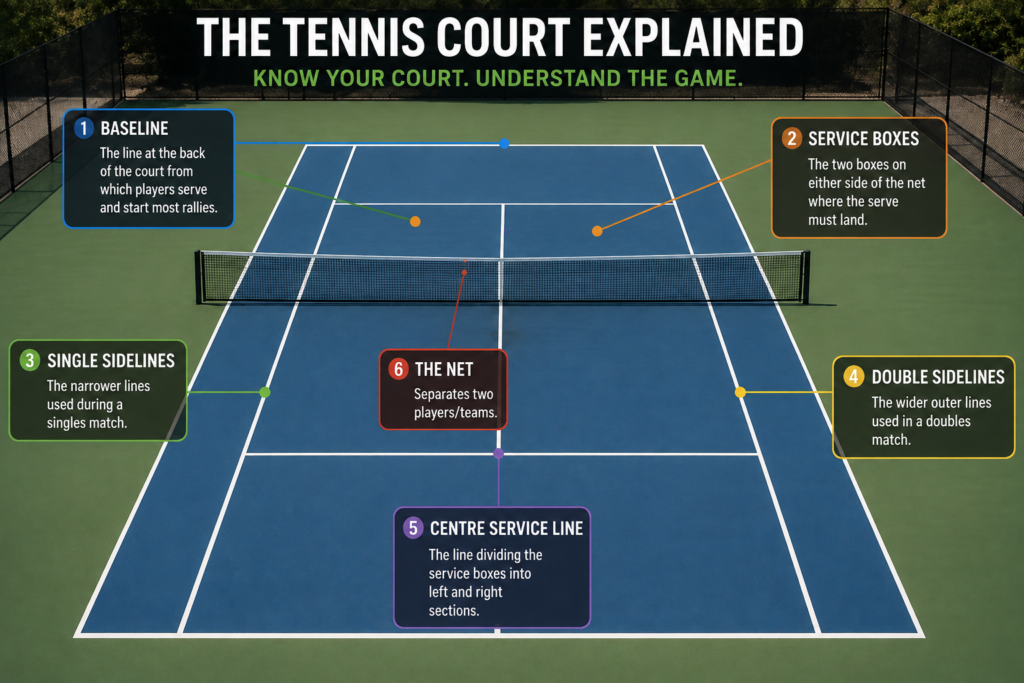
A tennis court is divided into different parts, each one serving a purpose. Knowing the different markings on the court can help you understand the rules of the game.
- Baseline: The line at the back of the court from which players serve and start most rallies.
- Service Boxes: The two boxes on either side of the net where the serve must land.
- Single Sidelines: The narrower lines used during a singles match.
- Double Sidelines: The wider outer lines used in a doubles match.
- Centre Service Line: The line dividing the service boxes into left and right sections.
- The Net: Separates two players/teams.
How Does Tennis Scoring Work?
Tennis has a unique scoring system that is unlike any other sport, especially rugby or soccer. Each game follows the same scoring system:
- Love (0)
- 15 (1)
- 30 (2)
- 40 (3)
- Game
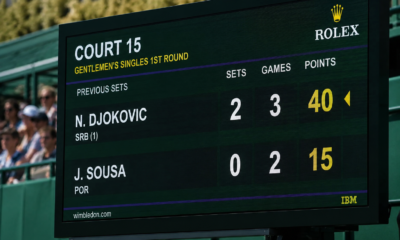
For example, 15-Love means the server has won one point. If the server gains another point and the other player gains a point, the score will be 30-15. ’30’ here means two points. If both players reach 40, the score becomes deuce.
What is Deuce?
Deuce means that both players have won three points. From deuce, winning one point means that the player has gained an advantage. Winning another consecutive point, Game is called. If they lose the next point, the game is back to deuce. This means that a player must win two consecutive points after deuce to win the game.
When deuce is called in a game, the pressure of the match is heightened. This in turn produces some of the most exciting rallies.
How Do You Win a Set?
A set is won by winning six games. But the player needs to have led at least two of the games. For example, a player wins if they win 6-0 or 6-4. If the score reaches 6-5, another game is played until one side has won by at least two games. If the score is 6-6, then a tiebreaker is usually played.
What Is a Tiebreaker?
A tiebreaker is played when a set reaches 6-6. Here, instead of normal scoring systems, players numerically count every point. The first player to reach seven points and has led by at least two, wins the game. If neither player leads by two points, then the tiebreaker continues until one player does. This is one of the main reasons tennis matches can be played for hours.
How Many Sets Are Played?
The number of sets is dependent on the tournament being played.
Best-of-Three Sets
This format is used in ATP and WTA Tour events, Olympic tennis, and most professional tournaments. Here, the first player to win two sets wins the match.
Best-of-Five Sets
This format is traditionally used in Men’s Grand Slam singles. Here, the first player to win three sets wins the match. These matches are longer and are seen to test both physical endurance and mental strength.

Tennis Serving Rules
Every point begins with a serve. The server must stand behind the baseline, toss the ball into the air, and hit it before it bounces. The ball must then land in the diagonally opposite service box. This is the point at which the stadium quietens, and the pressure is increased. Players alternate serving every game.
What Is a Fault?
A fault happens when a serve doesn’t land legally. For example, the ball misses the service box, hits the net without the ball landing correctly, or there’s a foot fault. After a fault has occurred, players have two attempts to make a legal serve. Missing both serves results in a double fault. Here, the point is automatically awarded to the opponent.
What Is a Let?
A let occurs when the serve touches the net or the ball still lands inside the correct service box. When this happens, the serve is replayed instead of a point being lost. There’s no limit to the number of lets that may occur after each other.
When Is the Ball Out?
A shot is considered out if it lands beyond the baseline, outside the sidelines, or outside the service box during a serve. But, if any part of the ball touches the line, it’s ruled as in.
Modern games use electronic line-calling technology to ensure decisions are made with complete accuracy.
Can the Ball Hit the Net?
During a rally, the ball can hit the net and still remain in play if it lands inside the opponent’s court. Only a serve has separate net rules. This is why you’ll occasionally see lucky shots roll over the net, and the opponents aren’t able to react in time.
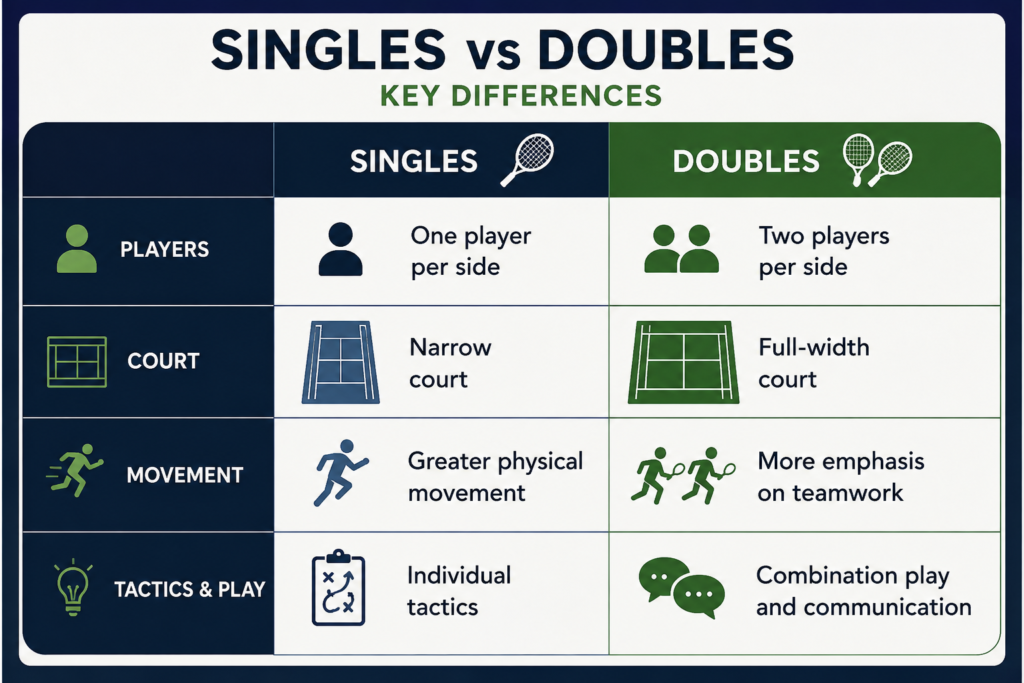
Singles vs Doubles Rules
Most tennis rules remain the same in both singles and doubles matches. However, there are a few differences that occur between the two.
Tennis Surfaces and Their Impact
Different court surfaces produce different styles of tennis. Hard, clay, and grass courts all have different speed rates, bounce rates, and uses. Understanding court surfaces and their uses becomes especially important when placing a bet.
Bet on Tennis with bet.co.za
Understanding tennis rules makes matches more enjoyable and helps give you a better vantage point for tennis betting. Once you know how scoring works, you’ll be able to analyse matches with ease. You’ll also be able to understand how and why momentum shifts during a game.
Explore the latest betting markets at bet.co.za and bet on tennis now.






Slot games
Slot Games of the Week to Try with Bet.co.za

Carling Currie Cup
Pumas vs Griquas: Preview and Predictions


Slot games
Slot Games of the Week to Try with Bet.co.za

F1 News & Updates
Belgian Grand Prix Review

F1 News & Updates
F1: Hungarian Grand Prix Preview And Predictions


F1 News & Updates
Austrian Grand Prix Review – Verstappen and Perez Shine in Spielberg

International And Local Golf News And Tournaments
Podcast: US Open Golf Betting Preview