Tennis is a game of skill, strategy and adaptability, but there is another factor that can have a major impact on how a match plays out: the court surface. The same player can look unbeatable on one surface and struggle on another because each court changes the speed, bounce and style of play.
From the fast pace of grass courts to the long rallies of clay and the balanced nature of hard courts, every surface brings different challenges. Understanding these differences can help you appreciate the game more and improve your tennis knowledge.
The three main tennis court surfaces used around the world are hard courts, clay courts, and grass courts. Each one has unique characteristics that influence player movement, shot selection and match tactics.

Grass Courts: The Fastest Tennis Surface
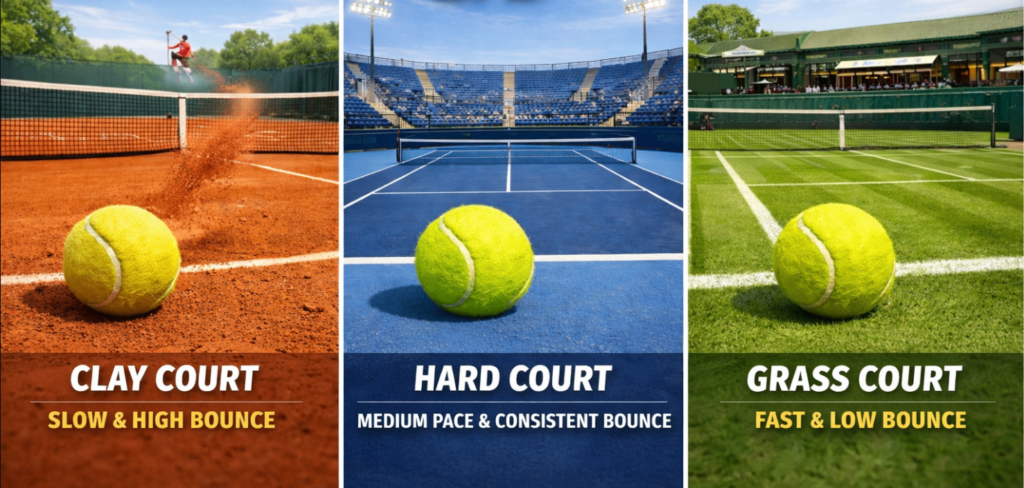
Grass courts are the traditional home of attacking tennis. Known for their speed and low bounce, grass courts reward players who can react quickly, serve strongly and take control of points early.
The smooth grass surface allows the ball to move quickly after contact, making it difficult for opponents to settle into long rallies. This is why big servers and aggressive players often perform well on grass.
Historically, grass courts were far more common in professional tennis. The US Open used grass courts until 1974, while the Australian Open continued using the surface until 1987. Today, the most famous grass-court tournament remains the Wimbledon Championships, which is the only Grand Slam event still played entirely on grass.
Advantages of grass courts
The biggest advantage of grass is speed. The ball stays lower and travels faster, giving attacking players opportunities to finish points quickly.
Grass courts also suit players with:
- Powerful serves
- Strong net play
- Fast reactions
- An aggressive playing style
Serve-and-volley players traditionally thrive on grass because they can follow their serve towards the net and attack with quick volleys before their opponent has time to respond.
Challenges of grass courts
While grass offers plenty of speed, it also creates challenges. The lower bounce can make timing difficult, especially for players who rely on long baseline rallies.
Grass courts also require significant maintenance. The surface needs regular care to remain playable, and rain can quickly disrupt matches because wet grass becomes slippery and unsafe.
Who is grass best suited for?
Players who enjoy attacking and putting pressure on opponents usually feel comfortable on grass. Those who prefer patience, long rallies and defensive tennis may find the fast conditions more difficult.
Clay Courts: The Home Of Long Rallies
Clay courts are famous for producing some of the longest and most physically demanding matches in tennis. Made from crushed materials such as brick, stone or shale, clay is the slowest of the three major tennis surfaces.
The slower speed gives players more time to reach the ball, making rallies longer and placing greater importance on fitness, movement and consistency.
The biggest clay-court tournament in tennis is the French Open, which has been played on clay since 1928.
Advantages of clay courts
Clay courts are ideal for players who enjoy controlling points from the baseline. The slower conditions allow competitors to use their groundstrokes, patience and defensive skills.
Another major feature of clay is spin. The rough surface grips the ball, helping players generate more topspin on serves and groundstrokes.
Benefits of clay courts include:
- Longer rallies
- More time to react
- Reduced impact on the body
- Greater reward for consistency and strategy
Because clay is softer than hard courts, it is also generally easier on players’ joints and muscles during long matches.
Challenges of clay courts
Clay courts require regular maintenance to stay in top condition. They need frequent watering and preparation to maintain the correct bounce and playing speed.
Winning on clay also requires patience. Players cannot rely on quick points and must often construct rallies carefully before finding an opening.
Who is clay best suited for?
Clay courts favour baseline players who enjoy extended rallies and using powerful groundstrokes. Players with strong movement, endurance and defensive ability often perform well on this surface.
A perfect example is Rafael Nadal, who earned the nickname “King of Clay” after winning 14 French Open titles.

Hard Courts: The Most Common Tennis Surface
Hard courts are the most widely used surface in professional tennis. They are made using layers of synthetic material placed over a concrete or asphalt base.
Unlike grass and clay, hard courts offer a more predictable bounce, allowing players to rely on consistent conditions throughout a match.
Hard courts are used at two Grand Slam tournaments: the Australian Open and the US Open.
Advantages of hard courts
The biggest benefit of hard courts is balance. They are not as fast as grass or as slow as clay, making them suitable for a wide range of playing styles.
Hard courts provide:
- Reliable bounce
- Consistent conditions
- A good balance between power and control
- Lower maintenance compared to natural surfaces
Indoor hard courts remove outside factors such as wind, rain and bright sunlight, allowing players to focus purely on their game.
Challenges of hard courts
Although hard courts offer consistency, they can be demanding on the body. The firm surface provides less cushioning than clay or grass, which can increase stress on players’ joints during frequent matches.
Outdoor hard courts can also be affected by weather conditions, especially rain and extreme heat.
Who is hard best suited for?
Hard courts reward all-around players. Big servers and aggressive hitters can succeed on faster hard courts, while slower hard courts favour players who build points patiently.
Because many professional tournaments are played on hard courts, developing a strong hard-court game is important for any serious tennis player.
Hi Tennis Twitter,
— The Tennis Letter (@TheTennisLetter) July 7, 2023
What’s your favorite match that was played on one of the 4 grandest courts in tennis?
Rod Laver Arena, Australian Open
Court Philippe-Chatrier, Roland Garros
Centre Court, Wimbledon
Arthur Ashe Stadium, US Open pic.twitter.com/MV6ROj51Zb
Grass vs Clay vs Hard Courts: Which Surface Is Best?
There is no single “best” tennis court surface. The ideal surface depends on a player’s strengths, style and preferences. Some factors to consider include:
Playing style
Aggressive players who like quick points may prefer grass, while defensive players and strong baseline competitors often enjoy clay. Hard courts suit players with an adaptable all-round game.
Experience level
Beginners may find hard courts easier because of their predictable bounce. Clay can be more forgiving physically, while grass requires quick reactions and strong movement.
Footwear and equipment
Different surfaces require different tennis shoes. Clay, grass and hard courts have different levels of grip, so choosing the correct footwear can improve movement and reduce the risk of slipping.
Personal preference
At the end of the day, comfort plays a big role. Some players enjoy the challenge of long clay-court rallies, while others prefer the speed and aggression of grass or the consistency of hard courts.
How Court Surfaces Shape Tennis History
Many legendary players have built their careers around their favourite surfaces. Pete Sampras dominated Wimbledon thanks to his powerful serve and attacking style but struggled to find the same success on clay.
Meanwhile, Nadal’s incredible clay-court record shows how a player’s strengths can perfectly match a specific surface.
The greatest players are often those who can adapt across all conditions. Success in tennis is not only about having powerful shots but also understanding how to adjust your game to different environments.
Bet on Tennis
Tennis court surfaces play a huge role in shaping matches. Grass creates fast and aggressive battles, clay produces physical rallies and strategic contests, while hard courts provide a balanced test of skill.
For tennis fans, understanding these differences makes watching tournaments even more exciting. For players, learning how each surface affects the game can help improve technique, strategy and overall performance.
Follow the latest tennis news, tournament previews and betting insights on Bet.co.za to stay updated on the biggest matches from around the world.






F1 News & Updates
Belgian Grand Prix Review

F1 News & Updates
F1: Hungarian Grand Prix Preview And Predictions


F1 News & Updates
Austrian Grand Prix Review – Verstappen and Perez Shine in Spielberg

International And Local Golf News And Tournaments
Podcast: US Open Golf Betting Preview