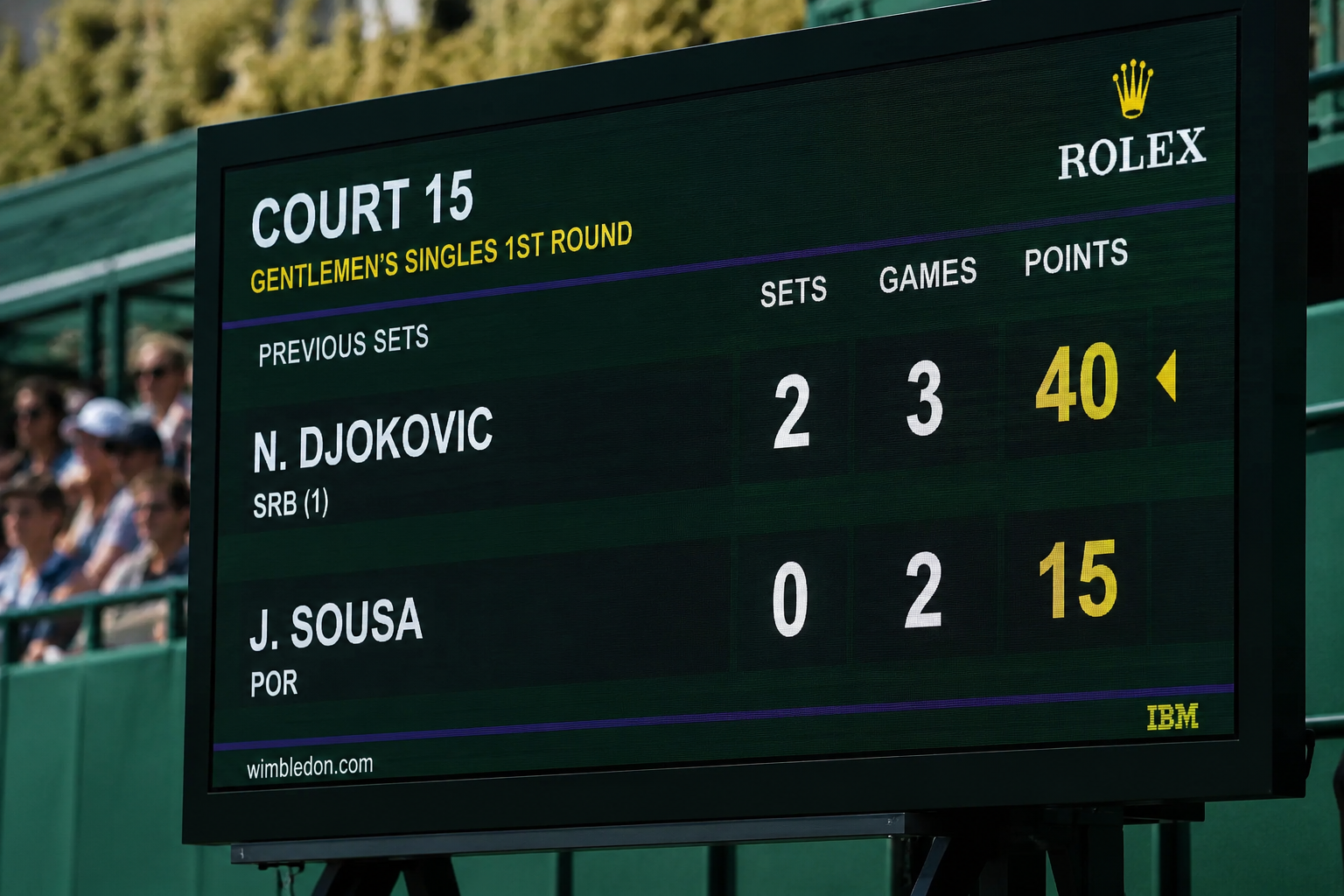
Tennis scoring is unlike any other sport’s scoring system. This makes it confusing at first and may cause you to have a few questions. Why does the score go from 15 to 30 to 40? Why do they keep saying “love”? And why are games sometimes so long?
Well, the good news is that once you understand the basics of tennis scoring, you’re set to understand the game. And luckily, tennis scoring is pretty straightforward.
Here’s everything you need to know about how tennis scoring works. We’ll take you through the basics such as points, games, matches, deuce, advantage, and tie-breaks. So, the next time you watch tennis, you’ll be a pro at actually understanding what’s happening.
How Tennis Scoring Works
A tennis match is made up of points, games, and sets. Players play for points (15, 30, 40) which make up a game. Games then make up a set. And sets determine the winner of the match.
For example, a player can win six games to take a set 6-4. This means that if they win 6 games and their opponent wins 4 games, they win that set 6-4. So, if they win two sets in the best-of-three matches, then they win the match. This is typically the format used in ATP and WTA matches.
Tennis Points Explained
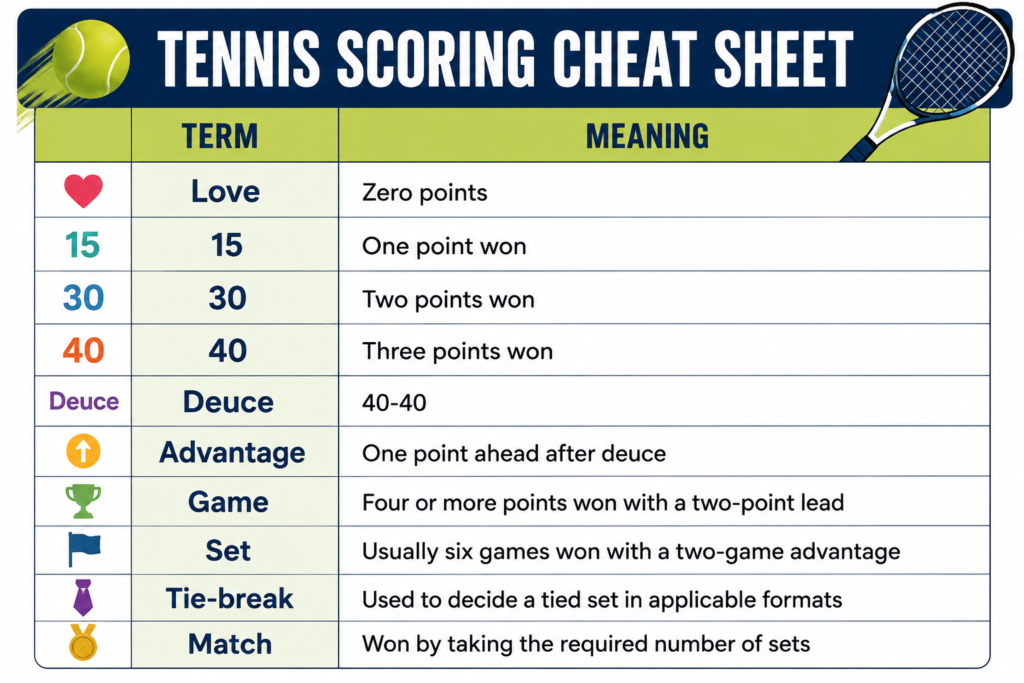
Tennis uses a unique scoring system that is straightforward once you understand it. Instead of using 0, 1, 2, 3, and 4, tennis has its own terminology. Each game follows the same scoring system:
- Love (0)
- 15 (1)
- 30 (2)
- 40 (3)
- Game, if two points ahead (4+)
So, if a player wins the first point of the game, the score becomes 15-Love. If they win again, the score becomes 30-love. If their opponent wins the next two points, the score becomes 30-30. Once a player reaches 40, they’re one point away from winning the game, as a game needs to be won by two points. This is unless the score reaches deuce.
What is Deuce in Tennis?
‘Deuce’ means that both players reached a score of 40-40 (3-3). From here, a player must win by two consecutive points to win the overall game. If they are only winning by one point, the game continues until there’s a two-point lead. When this happens, Game is called.
What is Advantage in Tennis?
After deuce is called, the next point a player gets gives that one player advantage. Here there are two possible types of advantage:
- Advantage In: The player who won the last point is one point away from winning the game.
- Advantage Out: The receiving player has one point to win the match.
So, advantage just means that if you win the next point after gaining advantage, you win the game. But if the player loses the next point, the game goes back to deuce.

How Do You Win a Tennis Game?
To win a tennis game, regardless of if it’s a Grand Slam or not, a player must win by at least four points and have a two-point advantage. These two points create the deuce and advantage system.
This means that a player must win six games in a standard set and be at least two games ahead. If the score reaches 6-6, a tie-break is played. But the exact rules vary depending on the competition and format played.
Tennis Tie-Break
A tennis tie-break is used to decide a set when the score is tied at 6-6. Here, instead of the normal scoring system, points are counted using regular numbers (1, 2, 3, 4, etc.). In a standard tie-break, the first player to reach seven points and lead by at least two wins the set. During a tie-break, every point feels bigger as the smallest mistake can decide the set.
In a tie-break, the serving order changes. The first server serves one point, and then the players usually take turns serving two points each. Players also change ends at regular intervals during the tie-break to maintain fairness.
Bet on Tennis with bet.co.za
Every point can change the momentum of a game, set, or match. Understanding how this point system works helps you understand the game of tennis. Points make up games, games make up sets, and sets determine the winner of a match.
So, the next time you watch a tennis match, you’ll be able to follow along and bet with confidence. Bet on tennis now with bet.co.za.
Frequently Asked Questions (FAQs)
Why is ‘zero’ called ‘love’ in tennis?
‘Scoring zero’ is called ‘love’ in tennis, after the French word for ‘egg’ or an old English phrase about playing for fun.
How does the scoring work in tennis?
Tennis scoring works off of points, games, sets, and matches.
Why is 15/30/40 in tennis?
The 15/30/40 scoring system used in tennis likely comes from medieval France. One explanation comes from the clock-face theory, where scores are moved by quarters of a clock. Another theory is the court-position theory, where players move forward 15 and 30 feet and then only 10 feet to avoid being too close to the net.
Do tennis sets go to 6 or 7?
Tennis sets can be played for 6 or 7 games. But a player must lead by at least two games to win. This means that a set can end at 6-4 or go on to 7-5 if the score is tied at 5-5. If the score ties 6-6, a tie-break is played. The final score is then 7-6 for the winner of the set.





Slot games
Games of the Week at Bet.co.za


F1 News & Updates
Singapore Grand Prix Betting Tips & Predictions
F1 News & Updates
Singapore Grand Prix Betting Tips & Predictions
Slot games
Games of the Week at Bet.co.za

F1 News & Updates
Belgian Grand Prix Review

F1 News & Updates
F1: Hungarian Grand Prix Preview And Predictions


F1 News & Updates
Austrian Grand Prix Review – Verstappen and Perez Shine in Spielberg

International And Local Golf News And Tournaments
Podcast: US Open Golf Betting Preview