New to the world of rugby? To the world of refs blowing the whistle? To scrums, rucks, and mauls? To hearing the phrase “playing advantage”? Or do you simply need a reminder of rugby rules? Well, no worries, we’ve got you covered with our complete guide to rugby rules.
Rugby might seem complicated at first. But luckily, you don’t need to know every rule in the World Rugby law book to enjoy the game. Once you understand the basic rules and the most common phrases used in the game, you’ll be able to follow every tackle, turnover, and try.
Here’s everything you need to know about the 80-minute game known as rugby.

Rugby Match Basics
Before we look at the laws of rugby, it’s useful to know how the game is played. Rugby union matches are 80 minutes long. The match is divided into two halves of 40 minutes each with a halftime break in between.
Each team is made up of 15 players on the field and 8 players on the bench. The aim of the game is to score more points than the opposition. This is done by scoring a try, kicking a penalty goal, or converting a try.
During a match, play is continuous as both sides battle for possession and territory. This is achieved through tactical decision-making, kicking, and physical strength.
The Key Rule
The most important rule any new fan must know is that the ball must be passed backwards or sideways, never forward. This is seen to promote teamwork and encourage strategic play. But the ball can always be kicked forward at any time.
What is a Knock-On?
A knock-on happens when a player accidentally drops or fumbles the ball forward off their hands or arms. The ball then touches the ground or another player. For it to be considered a knock-on, it has to be caused by hands or arms. Knee, head, or chest knocks don’t count as a knock-on.
After a knock-on happens, play usually stops. A try is awarded to the opposing team.
Understanding the Offside Rule
Although many find this rule confusing, it’s actually very simple. Players must remain behind the player carrying the ball. If they move in front of the ball or the last player on the team who played the ball, then offside is called by the referee.
Offside can be called after kicks and during rucks and mauls. For example, if a player joins a ruck from the side or stands in front of the hindmost foot before the ball has been played, a penalty is awarded.
Offside ensures that both teams have a fair chance of possession. It also ensures that there is space maintained across the field.
Rugby Set Pieces Explained
Rugby is restarted using set pieces. These are used when certain infringements are made, or the ball goes out of play.
Scrum
A scrum is used to restart play after minor infringements, such as knock-ons or forward passes. Here, eight forwards from each team bind together before the scrum-half feeds the ball in between the two packs.
Both teams compete for possession by pushing against one another. The hooker (one of the players in the front row) attempts to hook the ball back to their side.
The goal of the scrum is to win possession of the ball and launch an attack to control territory and momentum.
Lineout
A lineout restarts play after the ball has gone out of play. Play is restarted at the point at which the ball went into touch.
Players line up at the touchline while the hooker throws the ball between the two lines of players. Generally, teammates lift a jumper into the air. This allows them to catch possession before the opposition. The player that catches the ball keeps it and passes it to the backline, or a maul is created.

What Happens After a Tackle?
A tackle happens when the defending player stops the ball carrier by bringing them to the ground. This allows both teams to contest for possession of the ball. After the player is tackled, they must release the ball. The tackler must roll away from the tackle area.
It’s here that support players from both teams start to compete for possession. Generally, a ruck or maul is formed as play continues.
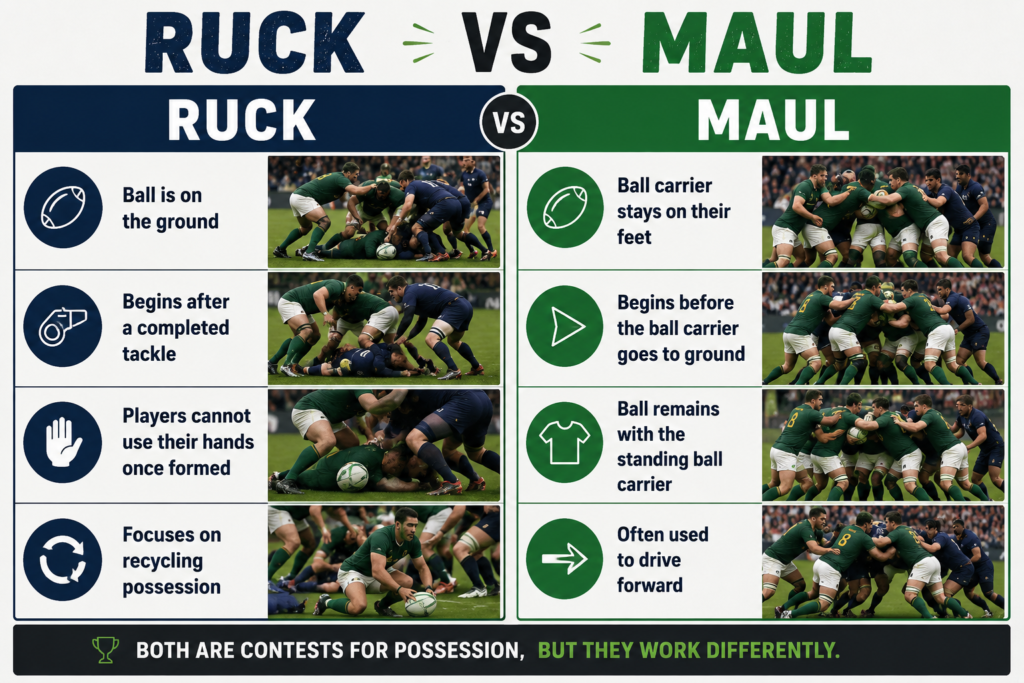
Option A: A Ruck
Because we’ve used this term a few times so far, your next question is probably, “What is a ruck?” A ruck forms when the tackled player is on the ground, and players from both teams bind over the ball.
Once the ruck has formed, players can’t use their hands to pick up the ball. Not only this, but players must join the ruck from behind the hindmost foot, or offside is called. As such, teams compete by driving over the ball with their feet and body position.
Generally, the scrum-half retrieves the ball from the ruck, and play is continued.
Option B: A Maul
Now what in the world is the difference between a ruck and a maul? A maul looks similar to a ruck, but the ball carrier remains on their feet while teammates bind to them. Defenders can join the contest and will most probably attempt to drive the formation forward.
Driving mauls from lineouts is a Springbok speciality. They regularly result in tries close to the opposition’s try line.
Understanding the Advantage Rule
If you’ve ever watched a game of rugby, you would have heard the ref calling “advantage”. This rule is used to continue play for the non-offending team. It’s used when the non-offending team has an opportunity to benefit from that play even though there was an infringement.
So, if the attacking team gains enough territory or possession, then play continues as normal. But if no advantage develops, the play is brought back to the original infringement. This rule helps keep the match flowing while rewarding attacking rugby.
Penalties and Free Kicks
When a rule is broken, free kicks or penalties are awarded by the referee. Penalties are awarded for being offside, high tackles, entering a ruck from the side, not releasing a tackled player, collapsing the scrum, or deliberately slowing the ball.
When awarded with a penalty, players can choose to:
- Kick for goals
- Kick for touch
- Take a quick tap (to continue play)
- Scrum
Yellow and Red Cards Explained
A yellow card is used for less serious infringements. The player leaves the field for 10 minutes. Play continues with 14 players during this time. Yellow cards are given for repeated team infringements, dangerous tackles, fouls, and deliberate cynical play.
There are two types of red cards in rugby. The first is a 20-minute red card where the team must play with only 14 players. The second is a permanent red card where “thuggish” acts are deemed as having a high degree of danger.
Bet on Rugby with bet.co.za
From watching Rugby’s Greatest Rivalry to following your favourite Currie Cup team, there’s nothing quite like the excitement of a rugby match. As the crowds scream with excitement over the latest move, the commentators uncomplicate the match by explaining what has happened. Now, you’ll be able to follow along at your next braai with what’s being said.
While rugby rules might seem complicated at first, they’re actually simple. They help you understand what’s happening in the game. So, whether you’re watching local or international rugby, the rules are the same and can help make you a more informed bettor. Explore the latest markets and bet on rugby now with bet.co.za.






Slot games
Slot Games of the Week to Try with Bet.co.za

Carling Currie Cup
Pumas vs Griquas: Preview and Predictions


Slot games
Slot Games of the Week to Try with Bet.co.za

F1 News & Updates
Belgian Grand Prix Review

F1 News & Updates
F1: Hungarian Grand Prix Preview And Predictions


F1 News & Updates
Austrian Grand Prix Review – Verstappen and Perez Shine in Spielberg

International And Local Golf News And Tournaments
Podcast: US Open Golf Betting Preview