Have you ever watched a rugby union match and thought, “Wow, that ref is moving their arms a lot”? Well, you’re not alone. Rugby referee signals are an essential part of the game. They help players, coaches, broadcasters, and fans understand every decision without needing a lengthy explanation.
Understanding these rugby referee signals helps you understand the game more confidently. From penalties to scrums to yellow cards and tries, each signal has a specific meaning. These movements keep the game flowing and ensure that everyone knows the ref’s decision.
Here are the most common rugby referee signals, what they mean, and when you will see them being used during a match.
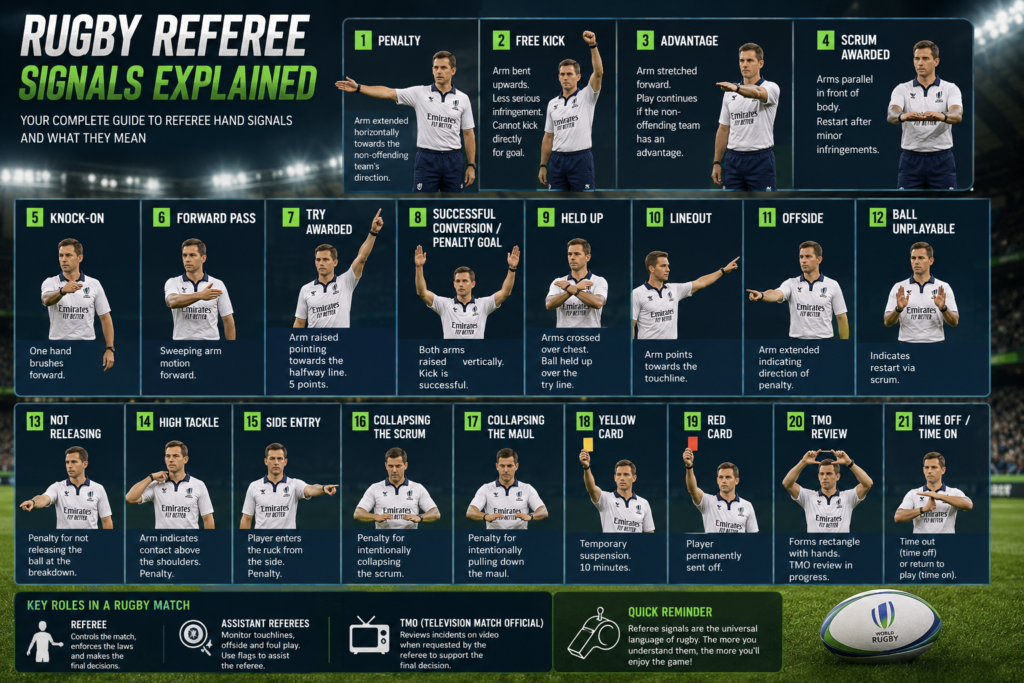
Why Rugby Referee Signals Matter
Rugby is a fast-paced sport that needs instantaneous communication. Stadiums are filled with thousands of fans screaming for their team. This makes verbal communication difficult. That’s where referee signals come in.
Gestures by the ref are designed for clear communication of decisions between teams, spectators, TV viewers, and commentators. They also help to keep the game flowing and ensure consistency across competitions.
So, it doesn’t matter if you’re watching a World Cup, the Nations Championship, the Carling Currie Cup Premier Division, or a local club game; the ref’s signals are standard around the world.
Who Uses Rugby Referee Signals?
- Referee: Controls the match, applies the laws of the game, awards penalties, controls the discipline of players, and indicates all major decisions.
- Assistant Referees: Help monitor the touchlines, foul play, offsides, and successful goal kicks using a flag.
- Television Match Official (TMO): Looks over video footage when asked by the referee.
The Most Common Rugby Referee Signals
Penalty
A penalty is given to a team when they commit a serious infringement. These infringements include being offside, high tackles, not releasing the ball, entering at the side of the breakdown, and collapsing the scrum or maul.
The team that did not cause the penalty gets to choose to:
- Kick for goals
- Kick for touch and gain territory
- Tap the ball quickly and continue with the attack
- Scrum
Signal: The ref extends one arm horizontally in the direction of play of the non-offending team.
Free Kick
Less serious infringements, like technical infringements at scrums or lineouts, result in a free kick. Unlike a penalty, teams can’t take a free kick directly at goal.
Signal: The ref raises one arm with a bent elbow.
Advantage
Advantage is called by the ref when one team commits a minor infringement. The non-offending team gains advantage and play is continued. This happens when the non-offending team looks like they are gaining territory or might score a goal. But, if no advantage develops, play returns to the original offence.
Signal: The ref extends one arm forward horizontally.
Scrum Awarded
Eight forwards from each team bind together and compete for possession. Scrums restart play after minor infringements such as knock-ons, forward passes, accidental offsides, and certain stoppages.
The scrum starts with the referee saying “crouch, bind, set”. The scrumhalf feeds the ball into the area created between them. The hooker then attempts to hook the ball back to their side.
Signal: Both arms are held out in front of the body, parallel to the ground.
Knock-On
A knock-on happens when a player loses possession forward of the ball off their hands or arms. This occurs after the ball touches another player or the ground. A scrum is usually awarded to the opposing team.
Signal: The ref lifts his hand forward.

Forward Pass
A forward pass happens when a player deliberately passes the ball forward to another player. This is unlike a knock-on which is accidental. Note, in rugby the ball can only go backwards or sideways making a forward pass illegal. A scrum is rewarded to the opposing team.
Signal: The ref sweeps an arm forward.
Try Awarded
A try is scored when the ball is grounded on or over the try line by the opposition. It is worth five points, making it the highest-value scoring action in rugby.
Signal: The referee points one arm towards the halfway line.
Held Up
Being held up means that the attacking player was unable to ground the ball over the try line.
Signal: Arms crossed over the chest.
Lineout
A lineout consists of a group of forwards from each team lining up at the touchline. The hooker then throws the ball between the two lines of players. Whichever team catches the ball keeps it and tries to score a try.
Signal: The ref points to the touchline where the lineout will happen.
Offside
A player is seen to be offside when they are in front of the ball or the last player on their team who had the ball. It can happen during open play, kicks, rucks, mauls, scrums, or lineouts.
Signal: The ref points in the direction of the penalty.
Not Releasing
Not releasing happens when the tackled player doesn’t release the ball or the tackled player.
Signal: The ref points to the offending player and awards a penalty.
High Tackle
A high tackle is called when the player tackles above the shoulders. It’s an illegal move and results in a penalty, yellow, or red card. The decision is dependent on the level of danger involved in the tackle.
Signal: The ref gestures to their neck or shoulders.

Side Entry
Players must enter the breakdown directly behind the hindmost foot of their own teammate. If you enter a ruck or maul from the side, you are offside. A penalty is almost always given in this case.
Signal: Same as a penalty.
Collapsing the Scrum/Maul
For a scrum, the front row must remain stable and be able to support their own weight. If the scrum is intentionally collapsed, a penalty is rewarded. Repeated offenses may cause a yellow card to be given.
For a maul, players can’t deliberately pull the maul to the ground. This, like for a scrum, is awarded a penalty, and repeated offenses may be given a yellow card.
Signal: Same as a penalty.
Yellow/Red Card
A yellow card results in a 10-minute suspension, while a red card is a 20-minute suspension with the possibility of a more serious suspension.
Signal: The ref raises a yellow or red card above their head.
TMO Review
The referee asks the TMO to review footage and helps the ref make a final decision. Things such as possible tries, foul play, dangerous tackles, obstruction, and knock-ons before scoring are often sent to the TMO for review.
Signal: The ref forms a rectangle with both hands.
Bet on Rugby with bet.co.za
One of the easiest ways to improve your understanding of rugby is to learn rugby referee signals. Once you know what each signal means, you’ll be able to follow the ref’s decisions with confidence, understand why penalties are awarded, and enjoy the flow of the match without confusion.
So, now no matter what rugby game you watch, you’ll be able to understand what the ref is doing. If this isn’t exciting enough, bet on rugby now with bet.co.za.
Frequently Asked Questions (FAQs)
What is the most common rugby referee signal?
The penalty signal is the most common, as many infringements result in a penalty being awarded.
What does the referee pointing forward mean?
It usually shows that advantage is being played. This allows the non-offending team to continue before the referee decides whether to stop play.
Why do rugby referees raise both arms?
Both arms raised above the head indicate that a conversion or penalty goal has been successfully kicked.
Are rugby referee signals the same in every competition?
Yes. The core rugby referee signals are standardised under the Laws of the Game and are used in domestic and international rugby union matches.






F1 News & Updates
Belgian Grand Prix Review

F1 News & Updates
F1: Hungarian Grand Prix Preview And Predictions


F1 News & Updates
Austrian Grand Prix Review – Verstappen and Perez Shine in Spielberg

International And Local Golf News And Tournaments
Podcast: US Open Golf Betting Preview