Rugby
Rugby Scoring Explained: How Many Points is a Try Worth?
Confused about rugby scoring? Learn how many points a try is worth, how conversions, penalty goals, and drop goals work, and discover the tactics behind every point scored.

New to the world of rugby? Well, you probably have loads of questions that need answers. The first question you probably have is, “How many points is a try worth?” Or “what even is a try?” We’re here to answer all these questions and explain the rugby points system in simple terms.
The rugby scoring system may seem complicated at first. But it’s actually quite simple once you get to know the different ways teams can score points. Fortunately, then, the rugby union uses the same scoring system for the United Rugby Championship, the Nations Championship, and the World Cup.
Here’s everything you need to know about rugby points, how to score them, and why some scoring opportunities are worth more than others.


Understanding the Rugby Scoring System
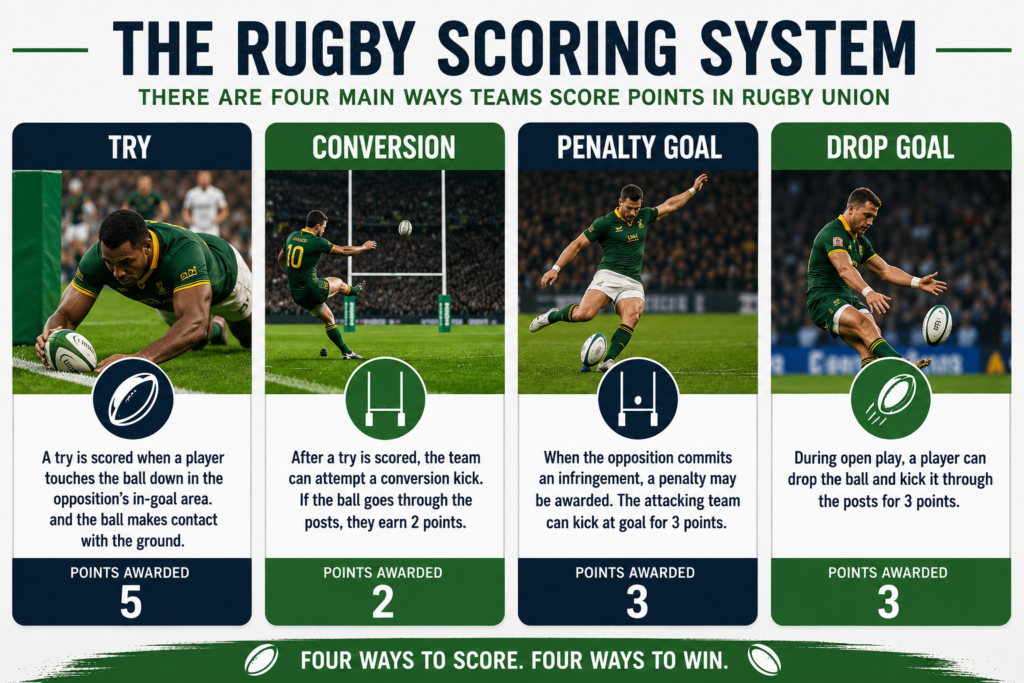
There are four main ways to score points in the rugby union. These are a try, conversion (a converted try), penalty goal, and drop goal. Every match consists of a combination of these scoring methods.
Teams decided on the way to score depending on the situation on the field. Let’s take a closer look at each scoring system in detail.

How Many Points is a Try Worth?
A try is worth five points. This makes it the highest-value scoring action in rugby, especially with their potential for a two-point conversion. As such, tries commonly occur during the game.
A try is scored when the ball is grounded on or over the try line by the opposition. Scoring a try is no easy task. It requires a break in the opposition’s defence. This happens after building sustained attacking pressure through many phases. But it can also happen as a result of individual brilliance.
Arguably, one of the greatest Springbok tries of all time was scored by Makazole Mapimpi during the 2019 World Cup Final against England. This try marked the Springboks’ third World Cup final win. It also showcased Mapimpi’s skills and vision on the field.

What is a Conversion?
After a try is scored, the attacking team can add two more points to the board by converting the try. This is called a conversion. A conversion is when the ball is kicked through the goalposts from a point in line with where the try was scored.
So, the conversion angle matters. The closer the try is scored to the centre of the field, the easier the kick becomes. This means that teams attempt to score a try closer to or under the posts to make the conversion easier.
When the conversion happens, the team receives two additional points. This means that a converted try is worth seven points in total.
Penalty Goals Explained
Teams can also score three points from a penalty goal. This happens when the opposition commits certain infringements. The referee may, as a result, award a penalty. An attacking team may opt for a penalty goal instead of kicking for touch or taking a quick tap.
If the ball goes through the uprights and above the crossbar, then you get three points. Here, strong kickers such as Sacha Feinberg-Mngomezulu, Handre Pollard, and Manie Libbok are incredibly valuable. They have been known to consistently convert a penalty into a three-point goal.
Penalties are awarded for offenses such as:
- Offside
- High tackles
- Collapsing scrums
- Not releasing the ball after a tackle
- Illegal entry into the ruck
- Repeated team infringements
What is a Drop Goal?
With drop goals, play continues as normal. The attacking player deliberately drops the ball onto the ground and kicks the ball immediately after it bounces. The ball is then kicked through the goal posts. If the ball goes through the posts, the team scores three points.
Drop goals are rare, as the player needs to have the right position on the field to get the ball through the posts. In other words, they’re within kicking range but can’t score a try.

Why Teams Don’t Always Choose the Three Points
Many of us have wondered why, when a penalty is awarded do players not go for the penalty goal. The answer here usually depends on the match situation. If the team is behind, scoring a converted try is more valuable than the three points from a penalty.
As a result, teams will favour kicking to the corner over settling for penalty kicks. This is especially true when teams have gained momentum. Remember, a converted try is worth seven points while a penalty is only worth three.
Rugby Scoring Strategy
Different teams build their game plans around different methods of scoring. Some rely on forward domination. It’s through scrums, mauls, physical carries, and forcing penalties that strategies come to light. For other teams, they score tries through fast passing, quick attacking rugby, and creating space out wide.
But the best teams, such as the Springboks, adapt their approach depending on the team they’re playing. Weather conditions also influence whether teams opt for penalty goals. Not only this, but in close knockout matches, where every point matters, penalty goals are used to gain advantage.
So, understanding the strategy behind rugby scoring helps to explain why some matches become high-scoring while others remain a defensively contested battle.
Bet on Rugby with bet.co.za
Now that you understand the rugby scoring system, following a match is so much easier. Join in on the shouting at the next braai and flex your newfound rugby knowledge.
If you’re looking to add an extra layer of excitement to the action, understanding rugby scoring allows you to better understand rugby betting markets on bet.co.za. Knowing how teams gain points helps you better understand markets such as total match points, winning margins, and try scorer bets. Bet on Rugby now with bet.co.za.
Frequently Asked Questions (FAQs)
What is the maximum number of points you can score from one attack?
The max number of points you can score is seven – five for the try and two for a successful conversion.
What is a penalty try?
A penalty try is when the team is automatically awarded seven points by the referee. They do not need to attempt a conversion. This happens when the other team has illegally prevented the team from scoring a try.
Can a rugby match end without a try being scored?
Yes, although uncommon. A match can be won through penalty goals and drop goals if neither team manages to cross the try line.
Do all forms of rugby use the same scoring system?
No. Rugby league uses a different scoring system. Tries are worth four points, and different rules govern the game.
Why is understanding rugby scoring important for betting?
Understanding rugby scoring can help you better understand popular betting markets on bet.co.za. Popular betting markets include total match points, winning margin, first try scorer, anytime try scorer, and correct score.