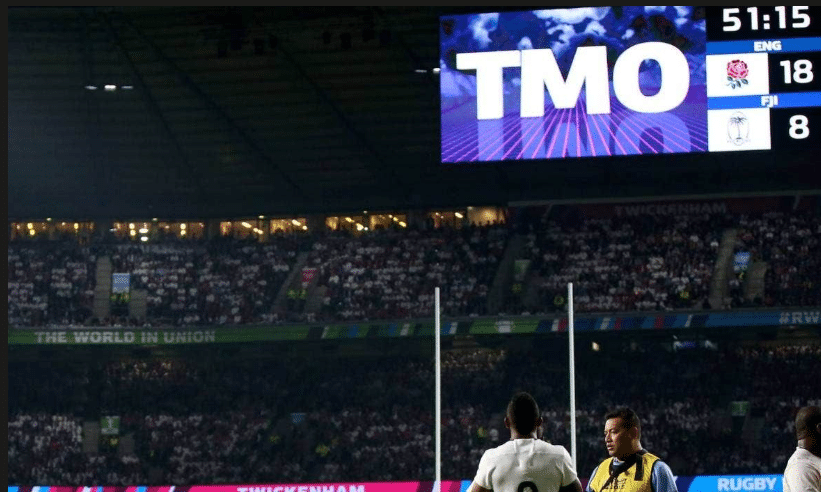
For as long as rugby union has been around, there’s been a man in the middle dictating the game. The referee, for more than a century, was the sole man on the field, blowing the whistle when an error was made.
Then came the invention of the TV, of recording and watching a play back. These features promised more objectivity when it came to decisions being made. And so, the Television Match Official (TMO) was introduced.
The TMO changed the way rugby was watched and played. It added a “bird’s-eye view” of the game, providing multiple angles for one play. But what is a TMO in rugby? When was the TMO introduced? How did it actually change the game of rugby?
We’ve put together this article to answer all these questions and more.

What is the TMO in Rugby?
The TMO, or Television Match Official, uses video technology to assist the referee and other officials in making key decisions or plays that occur during a match. But the TMO isn’t the referee. They’re simply there to provide access to match footage such as different camera angles, replays, slow motion, and other video technology.
They’re there to assist with examining these plays or tries from different perspectives and giving their input on what happened.
When was the TMO Introduced in Rugby?
The TMO was first introduced in rugby in 1995 in Pretoria during the Blue Bulls‘ Carlton League Final. The referee was Tappe Henning, and the TMO was Louis Wessels. This experimental usage of video review technology was based off of its usage in American football.
Back then, the TMO was used differently to what we know today. The TMO would give advice to the referee. Then more games became televised, and by 2000 it was used by the SANZAR (SANZAAR now) in the Super 12. It was used in the Hurricanes versus Sharks match.
By 2001, the TMO was adopted by World Rugby and by 2003, it had become part of a Rugby World Cup. As technology advanced, so too did the review functionality of a TMO.
The TMO Signal in Rugby

If you’ve ever watched a rugby game, you’ve probably seen the referee create a rectangle with their hands. This signal means that they are calling on the TMO.
A referee signals the TMO to review footage and help them with making a final decision. The TMO is called for review for things such as possible tries, foul play, dangerous tackles, obstruction, and knock-ons before scoring. They are also used to check the grounding of a ball in-goal, touch or touch-in-goal, seeing if a kick was successful, and prevention of a try.
So, the overall role of the TMO is to ensure that there aren’t unanswered questions from on-field play. They don’t become a second referee; instead, they’re used to help in seeing if the situations above are unclear on the field.
How Does a TMO Review Work?
The use of a TMO review is fairly simple. Something happens on the field that catches the attention of the referee or another officiating member. The ref stops play and signals for a TMO review. The TMO then works with the video replay operator to find the relevant footage and camera angles of that specific moment of play.
The TMO reviews the footage and communicates the relevant information back to the ref. The review is often played on the big screens in the stadium. The ref then makes a final decision regarding their original question.
So, How Has the TMO Changed Rugby?
The use of the TMO has significantly shifted rugby as a whole. It’s been used to help improve official decisions and change the rhythm of experience of matches.
1. Tries Can Be Checked From Multiple Angles
Before the TMO was used, refs and ref assistants had to make decisions based on what they saw in real time. This was difficult when multiple players became involved in scoring a try.
Grounding can occur under multiple players, a foot could touch the touchline, or a ball could be passed forward. All these could be missed. But with a TMO, these situations can be slowed down and replayed to be re-examined. This is arguably the biggest change to rugby officiating, the ability to replay moments of the game.

2. The TMO Has Made Marginal Decisions More Visible
With the advancement of technology, the role of the ref has changed. Before video review, an extremely close call was determined by a ref’s judgement. Now, there is more certainty with making a close call. The moment can be replayed and slowed down to help the ref make their decision.
3. The TMO Has Changed the Way Foul Play is Reviewed
Video reviews have now become crucial in carding dangerous or foul play. High tackles, dangerous contact, and other infringements can be viewed from multiple angles. This has resulted in more focus being placed on player welfare.
For example, the Foul Play Review Process, also known as the Bunker, was introduced to see if a player should receive a yellow or red card. The yellow card goes under review and can be upgraded to a red if the TMO has enough evidence to support it. Play is continued during this time.
4. The TMO Has Changed How Quickly Decisions are Made
This has become one of the biggest criticisms of video officiating as the TMO needs to review multiple replays and camera angles. This process comes with lengthy conversations.
World Rugby has tried to make this process faster by creating an “on-the-run” TMO decision-making process. This is done to get decisions right without creating unnecessary stoppages.
5. The TMO Has Influenced Rugby Laws
The TMO has evolved as rugby laws have evolved. In other words, changes to the game of rugby have been made to make it more like the game we know today. In this process, the TMO has advanced.
As of 2025, the TMO is used to make formal and live referrals. They can identify clear and obvious incidents in the final attacking stages before a try. These include knock-ons, forward passes, players being in touch or offside, and maul obstructions.
TMO vs VAR: Are They One in the Same?
While these two systems are similar, they don’t function the same. VAR, or Video Assisant Referee, acts as a secondary referee and is able to make decisions about the game. A TMO, on the other hand, assists the ref with making major decisions. However, the final decision still comes down to the ref on the field.
How the TMO Changed the Game of Rugby
As can be seen, the TMO is no longer a “try/no try” tool. They’re fully integrated into the rugby match and used throughout the game. As a result, they’re able to give officials information that didn’t previously exist before video technology. They’re able to provide the ref with more accurate decisions and see things that would’ve previously been missed.
But video footage is always up for interpretation. Camera angles can be blocked, players can obscure the ball, and slow motion can dramatise ordinary moments. Rugby still relies on the ref’s decisions.
Bet on rugby now with bet.co.za.






Slot games
Slot Games of the Week to Try with Bet.co.za

Carling Currie Cup
Pumas vs Griquas: Preview and Predictions


Slot games
Slot Games of the Week to Try with Bet.co.za
Carling Currie Cup
Pumas vs Griquas: Preview and Predictions

F1 News & Updates
Belgian Grand Prix Review

F1 News & Updates
F1: Hungarian Grand Prix Preview And Predictions


F1 News & Updates
Austrian Grand Prix Review – Verstappen and Perez Shine in Spielberg

International And Local Golf News And Tournaments
Podcast: US Open Golf Betting Preview