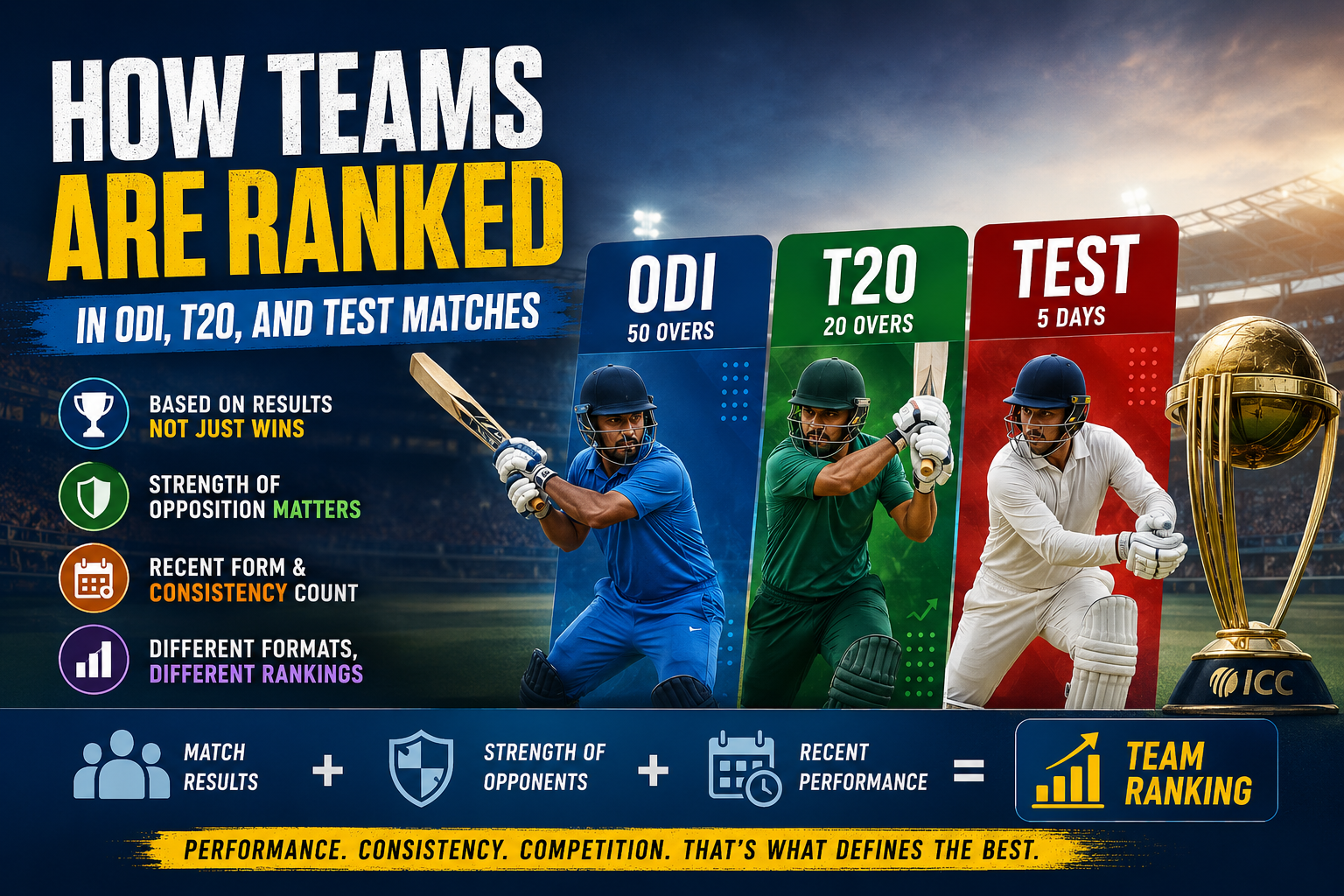
The International Cricket Council (ICC) uses a rating system that considers a team’s recent results and the strength of its opponents. ODI, T20, and Test cricket have different formats and playing styles and each format has its own team rankings.
In this article, we explain how cricket teams are ranked in ODI, T20, and Test matches, how points and ratings work, and why a team can rank differently across the three formats.
What Are ICC Cricket Team Rankings?
The ICC teams are compared based on their performance. The rating of a team is determined by the results of its matches and the performance of its opponents. The rating defines the place of the team in the ranking table. This means a win over a top-ranked team can be more valuable than a win over a lower-ranked team.

How Are Test Teams Ranked?
Test cricket is the longest format of the game; matches are normally played for about five days. Test team rankings are determined by performance over a longer period than limited-overs cricket.
The ICC Test rankings use a team’s match results and its opponents’ ratings to calculate its rating. Teams receive stronger credit for consistent performances against quality opposition.
For example, if a highly rated Test team defeats another highly rated team, the result can have a significant effect on the rankings. Conversely, losing matches can reduce a team’s rating.
Why Test Rankings Are Different
In Test cricket, the emphasis is more on sustained performance. To win over several days, a team needs strong batting, bowling, fitness, and tactical ability.
So, a team’s Test ranking can be very different to its ODI or T20 ranking. A team that is good at aggressive short-format cricket may not be among the best Test teams.
How Are ODI Teams Ranked?
ODI cricket is 50-over cricket. It’s longer than T20 cricket but shorter than Test cricket.
The ICC ODI rankings are based on the same principle of match results and quality of the opposition. Teams earn their rating by accumulating points from wins and other results in international competition.
If you are a team that wins ODI series and individual matches consistently against strong opposition, then your ranking is likely to improve.
What Affects an ODI Team’s Ranking?
Several factors influence a team’s ODI ranking, including:
- Matches won and lost
- Strength of the opposition
- Recent performance
- Results against higher- or lower-ranked teams
- The number of matches included in the ranking period
Consistency is mainly important. Winning one major ODI series does not automatically make a team the world’s No. 1 side.

How Are T20 Teams Ranked?
T20 internationals are the shortest of all standard international cricket formats and consist of a maximum of 20 overs per side.
T20 cricket is all about short bursts of performance. A few overs with bat or ball can change the course of a match dramatically.
The ICC T20I team rankings are determined by match results and the strength of the opponents. Some teams routinely beat the best in T20 Internationals and can climb up the rankings.
Why T20 Rankings Can Change Quickly
T20 cricket has a relatively high level of instability. A team can have several outstanding players and still lose a match because of a brilliant individual performance from the opposition.
As a result, maintaining a high T20 ranking requires consistent results rather than occasional tournament success.
What Is the Difference Between Points and Ratings?
One of the most important things to understand about ICC rankings is the difference between points and ratings.
Points represent the accumulated value of a team’s results in the ranking calculation. The rating is essentially the average strength of a team’s results over the matches considered. Teams are ordered according to their ratings.
This is why a team with more total points does not necessarily rank above every team with fewer points. The rating provides a way to compare teams based on performance and the relevant number of matches.
Bet on Cricket
The rankings for ODI, T20 and Test cricket are intended to assess the performance of international teams depending on their results and the standard of opposition they face. The basic idea is the same in all formats, but each format has its own table of rankings. The skills required for Test, ODI and T20 cricket are different.

A team’s position becomes more meaningful when put into perspective with its recent form, the strength of opposition, its make-up of the squad and its performances in major tournaments.
If you are a cricket fan, understanding how ICC rankings work makes it easier to understand why teams are moving up and down the rankings and why the world’s best teams have to keep performing well against strong international opposition. This information can also help you to make the right decision before placing a bet on cricket with Bet.co.za.





F1 News & Updates
Bahrain Grand Prix in Malaysia Betting Tips & Predictions


F1 News & Updates
Belgian Grand Prix Review

F1 News & Updates
F1: Hungarian Grand Prix Preview And Predictions


F1 News & Updates
Austrian Grand Prix Review – Verstappen and Perez Shine in Spielberg

International And Local Golf News And Tournaments
Podcast: US Open Golf Betting Preview