Rugby
Rugby Positions Explained: Numbers, Roles, and Responsibilities
New to rugby and confused by all the jersey numbers? This guide breaks down every rugby position, explaining their roles, responsibilities, and the Springbok stars who have mastered them.

With 15 players on the field, each holding a different position, rugby can be complicated. Each player plays a specific role on the field. In other words, their position determines their responsibilities during attack, defense, and set pieces.
Once the whistle blows and the numbers become a blur, it’s even harder to know what’s going on. Let’s uncomplicate the positions and explain the numbers, roles, and responsibilities of each player simply.


Understanding Rugby Player Positions
A rugby union team consists of 15 players, each of which has a specific position, role, and jersey number. The positions are divided into forwards (numbers 1-8) and backs (numbers 9-15).
Forwards
Your forwards are your big players. They’re the ones who are responsible for winning possession at scrums and lineouts, securing the ball at rucks and mauls, carrying the ball into contact with the other team, and defending around the breakdown.
In other words, the forwards do all the physical work. They help their team gain territory and take on the other big guys to make room for the backs to score points.
Backs
Your forwards are your smaller players. They are often faster and more agile to create attacking plays, exploit space, and finish scoring opportunities. They’re generally the ones who pass and kick the ball.
Put simply, the backs make the exciting runs and set up and score the tries. They use their speed and skill to move the ball around the field while breaking through defensive lines.
Rugby Positions Explained: The Forwards (1-8)
1. Loosehead Prop
A loosehead prop head locks into the opposition’s tighthead in the scrum. Their role is to support the hooker and apply pressure backwards and upwards. Outside of the scrum, they are used as ball carriers in the midfield and play a role in making crucial tackles.
Think of Ox Nche or Steven Kitchoff. These loosehead props are known for their scrumming power and physicality.
2. Hooker
The hooker is in the middle of the front row in the scrum. Their main role is to hook the ball during scrums and throw accurately at lineouts. They carry hard and tackle harder.
When we think of great hookers, we immediately think of the modern-day legend Malcolm Marx. Marx is known for his accurate lineouts and physicality.
3. Tighthead Prop
As one of the most physically demanding positions, the tighthead prop provides stability within the scrum. Not only this, but they also play a key role in rucks and mauls. Without them, the scrum would collapse, and territory wouldn’t be gained.
Thomas du Toit (“The Tank”) is the ultimate example of a “Bomb Squad” tighthead prop. He is known to make up to 10 tackles within 50 minutes.
4 and 5. Lock
Locks are usually your tall guys. They help to secure possession at the lineouts and provide power within the scrums. Think of number 4 as the guy who jumps in the lineouts.
Eben Etzebeth and RG Snyman are prime examples of locks. Both standing well over 6 feet, these men truly are some of the modern greats of the game. Their physical presence and leadership abilities set them apart as locks.
6. Openside Flanker
Openside flankers are your fast guys and the first ones at the breakdown. They play an important role in contesting possession. Not only this, but they play a key role in shifting momentum during the game. They aim for brutal tackles and are the link in open play.
Legends such as Siya Kolisi have worn this jersey. As an openside flanker, he is constantly on the move and is one of the first players at the breakdown. He is known for his tackling and competing ability at a ruck.
7. Blindside Flanker
Binding into the lock on the short side of the scrum, the blindside flanker is key when it comes to physicality. They are known for making important tackles, carrying the ball into contact, and gaining ground.
Here we think of the one and only Pieter-Steph du Toit. As a blindside flanker, he focuses on tackling, winning turnovers, and disrupting an attack from the opposition.
**Note: In South Africa number 7 and number 6 are swapped around. In the rest of the world, number 6 is a Blindside Flanker, and number 7 is an Openside Flanker.
8. Number Eight
The eighth man is the link between the forwards and the backs. They control the ball at the back of the scrum. Further, they are responsible for deciding if they should keep the ball, run with it, or release it to the backs.
Recently retired Duane Vermeulen is one of the top eighth men of all time. His ability to carry, be defensive, and get involved in the breakdown make him a legend in the number 8 jersey.

Rugby Positions Explained: The Backs (9-15)
9. Scrumhalf
Like the number eight, scrumhalf acts as a link between the forwards and backs. They are responsible for throwing key passes and kicking with accuracy. Even though they are often the smallest players on the field, they possess one of the biggest decision-making roles.
When we think of modern scrumhalves, we can’t help but think of the luscious locks on Faf de Klerk. de Klerk, although only 1.70m, is a player who can hold his own. He is able to pass the ball quickly and control the pace of the game.
10. Flyhalf
As the heart of the team, the flyhalf is the most influential player on the pitch. Almost every attacking phase of play goes through them. During this time, they decide if they should run, pass, or kick the ball for position. They must be calm under pressure and be able to put in big tackles.
Think of Handre Pollard. He is known for his direct attacks and impressive kicking abilities.
11. Left Wing
The left wing is responsible for scoring tries, usually around the left touchline. They do this through their impressive speed and agility. Their speed also helps them dodge defenders and contribute to offensive and defensive plays. Overall, they are essential in fast-paced plays and making key decisions.
Players like Cheslin Kolbe show why wingers are so important. Scoring 20 tries in 44 appearances with the Springboks, he shows why speed is so crucial for this position. He can change the game in an instant and is able to turn a half-chance into a try.
12. Inside Centre
Often closest to the flyhalf in the backline, the inside centre is crucial for both attack and defense. They bridge the gap between flyhalf and outside centre. In doing so, they combine physicality, tactical awareness, and ball-handling skills, using these to break the defensive line and create space for teammates. They are positioned in the midfield and are crucial for stopping opposing attacks with strong tackles.
Combining strength and skill, Damian de Allende is able to create attacking opportunities as an inside centre. He plays with the physicality of a forward and brings impressive passing skills to the game.
13. Outside Centre
Number 13, also known as the outside centre, is a key backline player. They are responsible for breaking defensive lines and creating space for the wings to break through. Further, they need to be able to pass accurately in both directions and tackle effectively to prevent attacks from spreading wide.
One of the best examples of a modern outside centre is Jesse Kriel. He is an elite two-way centre with a high work rate and impressive skills in defense and speed.
14. Right Wing
Like the left wing, the right wing is known for their speed and agility. They are responsible for finishing off moves and scoring tries. This is done by exploiting space, carrying the ball effectively, and identifying gaps.
Alternating with Cheslin Kolbe as left winger, Kurt-Lee Arendse shows what it means to be a right wing. His speed and attacking abilities help him turn half-chances into converted tries.
15. Fullback
As the last line of defense, a fullback launches counter-attacks and provides support along the backline. They use tactical kicking and ensure clean catches to regain possession of the ball.
Few fullbacks have the speed and skill of Aphelele Fassi. He combines these abilities with composure under pressure and being reliable under the high ball. His potential in the game is undeniable.
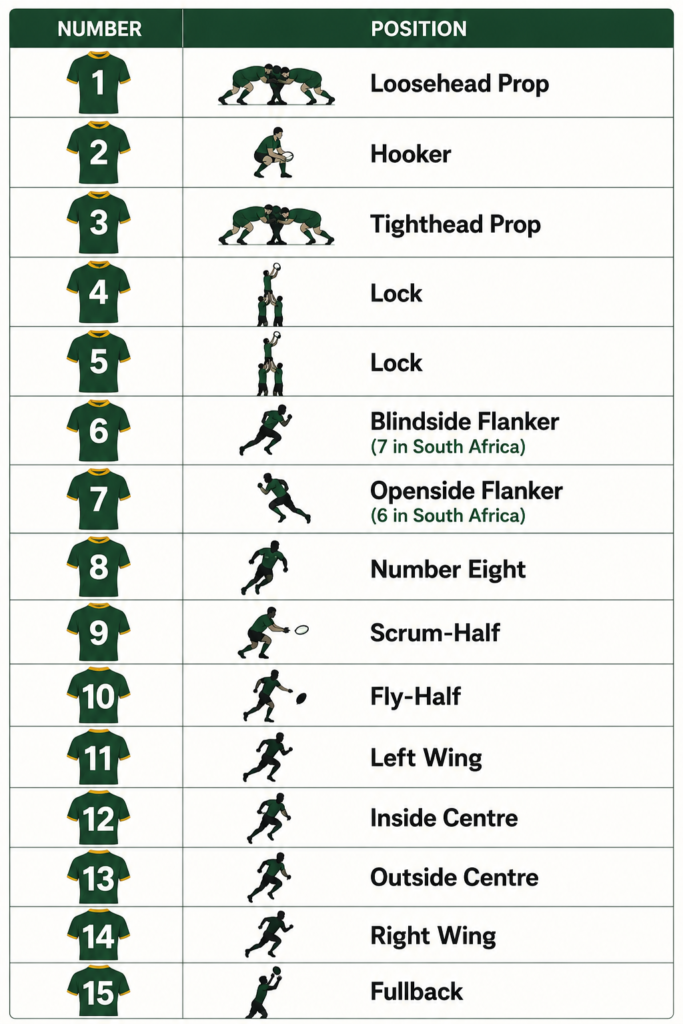
Rugby Jersey Numbers Explained
The simplest way to identify a rugby player’s position is by their jersey number. Here’s a breakdown of the number and their position.

Bet On Rugby With Bet.co.za
At first glance, a rugby pitch looks like absolute chaos. Players are running at each other seemingly out of nowhere, and the ball is constantly being kicked. But once you start to understand why the players do what they do, the game becomes simple.
So, the next time international rugby or the United Rugby Championship is on, remember to check the jersey number to know why that player is doing what they’re doing.
Now that you understand the game, bet on rugby now with bet.co.za.
